
 Australia
 Singapore
 India
India
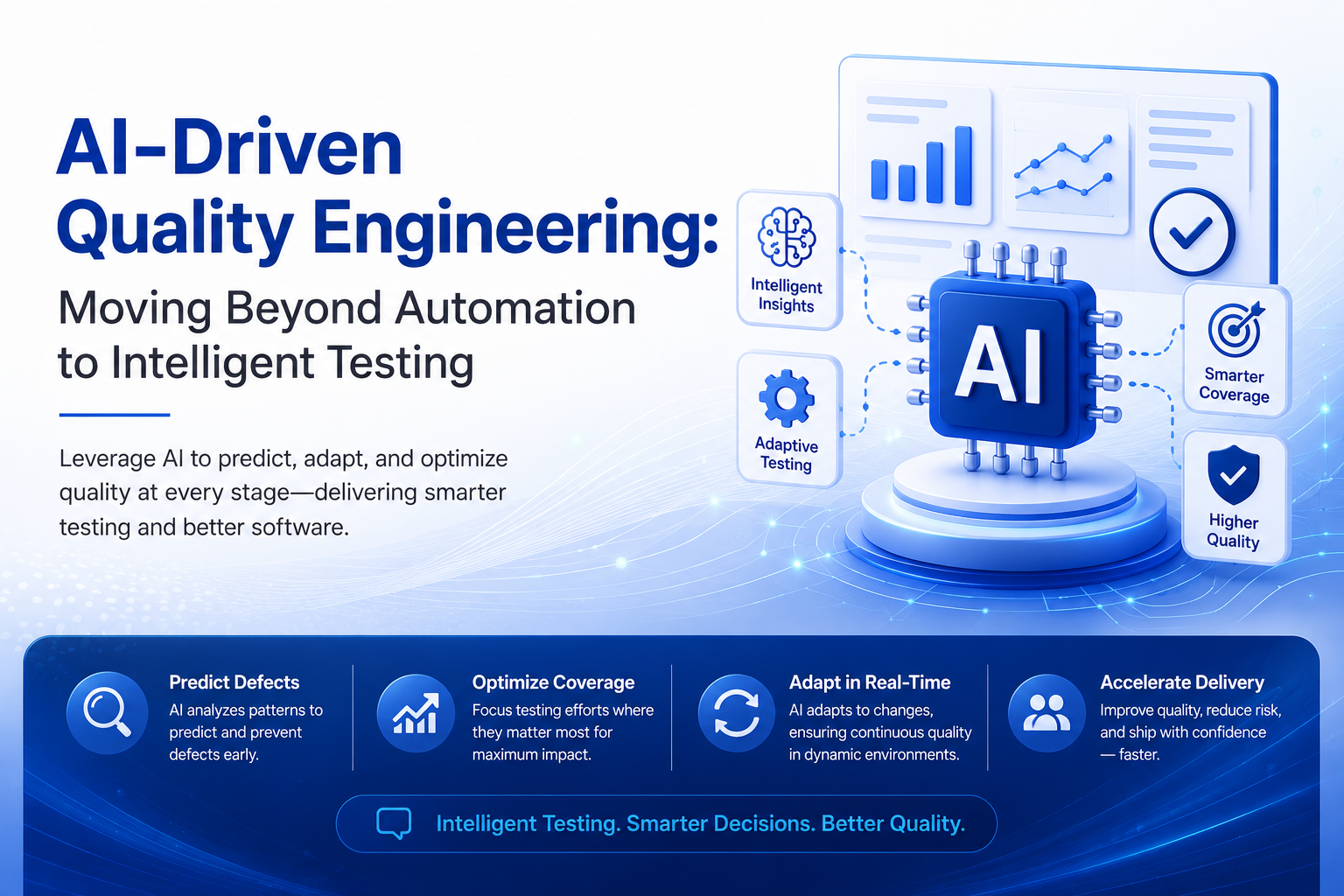
The demand for faster, higher-quality software has fundamentally changed how organisations approach testing. While test automation services have become a standard fixture in modern development workflows, they are no longer enough on their own. Today, forward-thinking businesses are adopting AI in software testing to achieve a new level of efficiency, adaptability, and reliability.
AI-driven quality engineering marks the next phase of this evolution, where testing is not merely automated but genuinely intelligent.
What Sets AI-Driven Testing Apart from Traditional Automation
Conventional test automation services depend on predefined scripts. These scripts execute efficiently but break when applications change, requiring costly manual updates. AI-driven testing takes a fundamentally different approach: it uses data, machine learning algorithms, and pattern recognition to continuously adapt and improve.
This shift enables capabilities that scripted automation simply cannot match:
- Dynamic test execution that prioritizes high-risk scenarios in real time
- Real-time defect detection that identifies anomalies before they escalate
- Automated decision-making that reduces reliance on manual oversight
The result is a testing process that becomes smarter with every release cycle.
Key Advantages of AI in Software Testing
Faster Testing Cycles AI intelligently prioritizes critical test scenarios, reducing execution time without sacrificing coverage. Teams release faster without compromising quality.
Higher Accuracy Complex, intermittent defects that slip through manual and scripted testing are routinely identified by AI models trained on historical failure data.
Lower Costs Reduced script maintenance, fewer escaped defects, and optimized resource allocation translate directly into lower overall testing costs over time.
Broader Coverage AI ensures comprehensive validation across edge cases, environment variations, and user journeys that human testers and static scripts routinely overlook.
Real-World Applications
Businesses across industries are already deploying AI in software testing to drive measurable outcomes. Common use cases include:
- Regression testing automation — AI selects and runs only the most relevant tests after each code change, dramatically cutting cycle times.
- Visual UI validation — Computer vision models detect pixel-level rendering issues across devices and browsers.
- Performance prediction — AI analyzes patterns to forecast performance degradation before it impacts production.
- Security testing — Intelligent models identify vulnerabilities that rule-based scanners frequently miss.
Choosing the Right Test Automation Partner
Not all test automation services are built for the AI era. When evaluating providers, look for:
- A mature AI-enabled testing platform with proven tooling
- Scalable solutions that evolve with your development velocity
- Deep domain expertise across your technology stack
- Transparent reporting and continuous model improvement practices
The right partner doesn’t just automate your existing process — they help you reimagine it.
Elevate Your Quality Engineering Strategy
AI-driven quality engineering is redefining how organisations deliver software on a scale. Businesses that move beyond traditional automation gain a compounding advantage: faster releases, higher accuracy, and lower risk sustained across every sprint.
Our advanced test automation services, powered by AI in software testing, are designed to help you deliver high-quality software faster and more reliably than ever before.
Talk to our experts today and discover how intelligent testing can transform your quality engineering approach. Your AI-driven testing journey starts here.