
 Australia
 Singapore
 India
India
Testing delays can slow down software releases and frustrate development teams everywhere. Traditional testing methods often struggle to keep pace with modern development cycles. AI-driven quality engineering transforms how teams approach testing challenges and eliminates common roadblocks. This revolutionary approach brings speed, accuracy, and efficiency to the entire testing process.
Understanding Testing Bottlenecks in Modern Development
Software testing faces several challenges that create bottlenecks in the development pipeline. Manual testing consumes valuable time and resources that teams desperately need elsewhere. Regression testing becomes increasingly complex as applications grow and evolve over time. Test coverage gaps often remain undetected until critical issues surface in production environments.
Teams struggle with:
● Repetitive manual tasks that drain productivity
● Limited testing resources during peak development periods
● Delayed feedback loops that slow down release cycles
● Inconsistent test results across different environments
How AI Transforms Quality Engineering
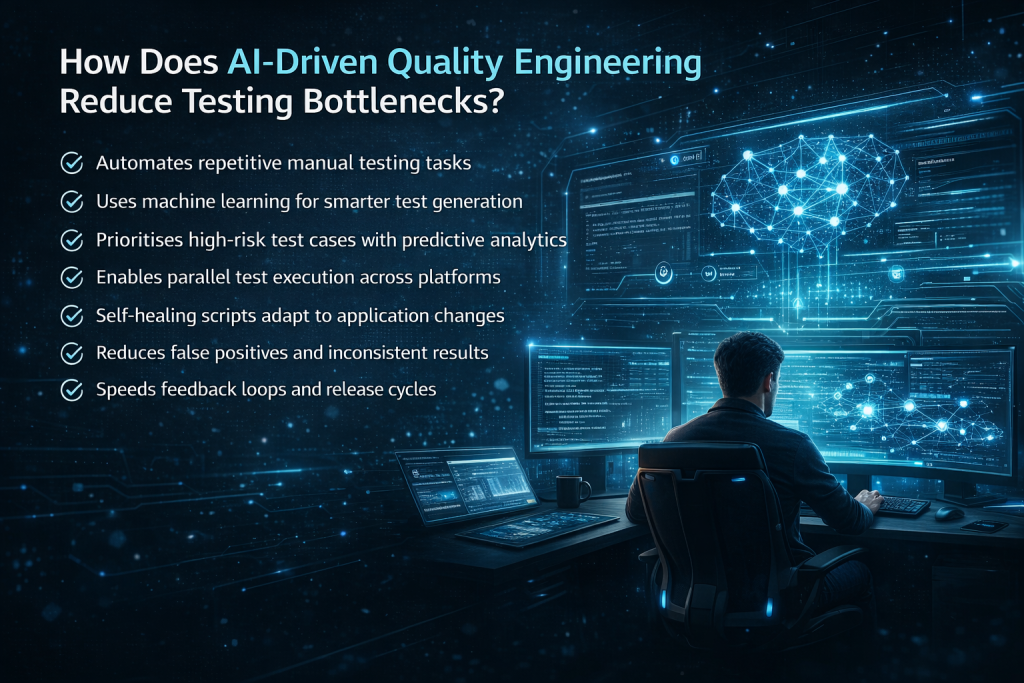
Quality engineering services in Sydney now leverage artificial intelligence to tackle these persistent challenges. Machine learning algorithms analyse vast amounts of testing data to identify patterns. These systems learn from previous test cycles and continuously improve their effectiveness. Automated test generation reduces the manual effort required for comprehensive coverage.
AI-powered tools excel at predictive analytics that forecast potential defects early. They prioritise test cases based on risk assessment and historical failure rates. This intelligent approach ensures teams focus resources where they matter most. Teams specialising in quality assurance in Sydney report significantly faster testing cycles with AI integration.

Key Benefits of AI-Driven Testing Solutions
Quality engineering consultancy experts highlight multiple advantages of adopting AI-powered testing frameworks. Intelligent test automation handles repetitive tasks while humans focus on complex scenarios. AI systems execute thousands of test cases simultaneously across multiple platforms. This parallel processing capability dramatically reduces overall testing time and effort.
The technology offers:
● Self-healing test scripts that adapt to application changes automatically
● Enhanced defect prediction capabilities that catch issues before they escalate
● Reduced false positives through smarter test result analysis
● Improved test coverage without proportional increases in testing time
Implementing AI in Your Testing Strategy
Quality engineering consultancy in Sydney professionals recommend a phased approach to AI adoption. Start with high-impact areas like smoke testing and regression suites first. Integrate AI tools gradually into existing workflows to minimise disruption and resistance. Train team members on new capabilities to maximise the technology’s potential.
Experts offering AI-driven quality engineering in Sydney emphasise continuous learning and adaptation throughout implementation. Monitor metrics like test execution time and defect detection rates regularly. Adjust strategies based on data-driven insights to optimise results over time.
Conclusion
AI-driven quality engineering eliminates testing bottlenecks that traditionally slow software delivery cycles. By embracing intelligent automation and predictive analytics, teams achieve faster releases with better quality. The future of software testing lies in smart, adaptive systems that learn and improve.
Ready to transform your testing approach and eliminate bottlenecks in your development process? Contact Adactin Group Pty Ltd at 61 420 983 561 or email [email protected] today. Visit www.adactin.com to discover how we can optimise your quality engineering strategy.
FAQs
1. What are the main testing bottlenecks in software development?
Common bottlenecks include manual testing delays, limited resources, and slow feedback loops. Complex regression testing and inconsistent results also create significant roadblocks for teams.
2. How does AI reduce time spent on testing?
AI automates repetitive tasks and executes multiple tests simultaneously across different platforms. It prioritises high-risk areas and generates test cases automatically, significantly reducing overall effort.
3. Can AI completely replace manual testing?
No, AI complements manual testing rather than replacing it entirely. Human testers remain essential for exploratory testing, usability evaluation, and complex scenario analysis.
4. What is self-healing test automation?
Self-healing tests automatically adapt when application interfaces or elements change without manual intervention. This capability reduces maintenance overhead and keeps test suites running smoothly.
5. How accurate is AI in predicting software defects?
AI prediction accuracy improves continuously as systems learn from more data over time. Most organisations report 70–85% accuracy in identifying potential defects before they reach production.
6. What types of testing benefit most from AI?
Regression testing, performance testing, and API testing gain the most immediate benefits from AI. These areas involve repetitive tasks that AI handles exceptionally well and efficiently.
7. How long does AI implementation take in testing processes?
Implementation timelines vary based on existing infrastructure and team readiness, typically ranging from weeks to months. Phased approaches allow teams to see benefits gradually while minimising disruption.
8. Does AI-driven testing require specialised technical skills?
Basic AI testing tools are user-friendly and accessible to traditional testers with proper training. Advanced customisation may require data science or machine learning expertise for optimal results.
9. How does AI improve test coverage?
AI analyses code changes and application behaviour to generate additional test scenarios automatically. It identifies untested paths and edge cases that human testers might overlook.
10. What ROI can organisations expect from AI testing tools?
Most organisations report a 30–50% reduction in testing time and significant cost savings within months. Long-term benefits include improved software quality, faster releases, and reduced production defects.